Yahoo Messenger does Flex

•03May07 • 2 Comments

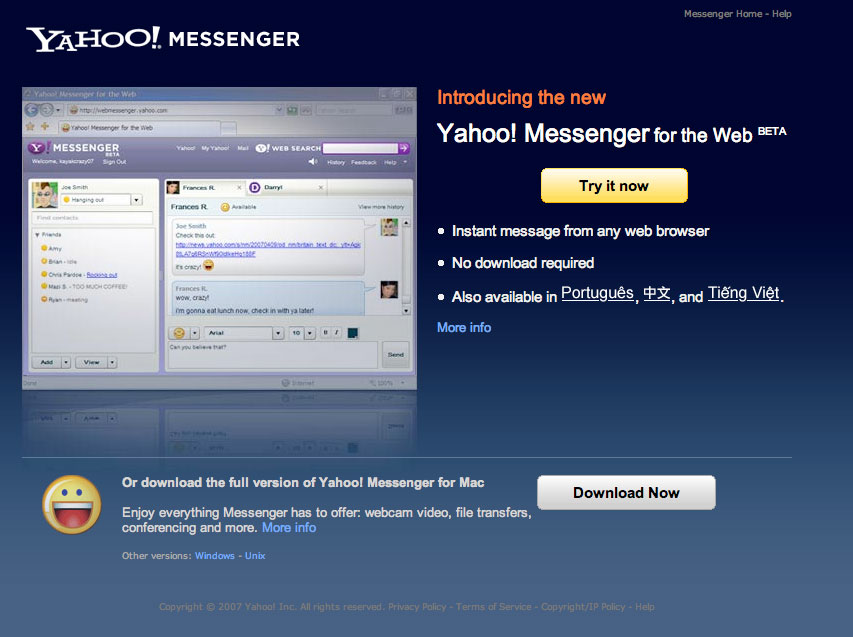
Today Yahoo! released a new Yahoo! Messenger for the Web client written using Flex. Its got a nice UI and it runs in your browser. It even shows Flash-based ads, which you may or may not consider a plus.

Ryan Stewart wrote a good writeup, and at the end he says:

One other intriguing thing about this is what it may mean for a Yahoo Messenger desktop client on the Mac. The Yahoo team put together a great Windows Presentation Foundation client for Vista, but that would be difficult to port to the Mac. This version on the other hand, because it was built with Flex, would be easy to turn into an Apollo application so it could run outside the browser on either PCs or Macs.

With all due respect to Ryan, I think he missed the point here. The WPF version of Yahoo! Messenger was a Microsoft evangelism project. Microsoft paid for some or all of its development, including the high ticket design work by Lee Brimelow and company at frog. That’s why Yahoo! didn’t promote the WPF player much on its own properties: the real client for the work was Microsoft, not Yahoo!. Is it cool? Yes. But it is not part of the mainstream product strategy for Yahoo! Messenger, because WPF’s installed base is only a small percentage of the world’s computers.

Contrast that with the new Yahoo! Messenger for the Web release, which Yahoo! is promoting heavily on its web site. Here’s a partial capture of the screen I got today when I went to http://messenger.yahoo.com on my Mac:

Yahoo Messenger for the Web promo screen

Check out the bullet points on the right of the screen: works in any browser, no download required, localized in multiple languages including Vietnamese and Portuguese (are these big IM countries? must be…). Those benefits say it all: Yahoo! isn’t doing this because Adobe outspent Microsoft on evangelism (as if!), they’re doing it because the platform offers compelling benefits to Yahoo! and its users today. Bet Microsoft wishes it could say the same…

A MIXed Bag

•30Apr07 • 5 Comments

So I’m here at Mix07, and thought I’d write down my impressions from the first day’s sessions. The first was the keynote, a two and a half hour affair. After lunch I attended the Open Source panel.

Ozzie’s speech was good but not great. He was confident, his slides were a lot less busy than those billg used in his keynotes, and there was clearly a lot of thought put into the messaging. But he ultimately failed to explain why his vision of finding the balance point between desktop APIs and web APIs was compelling or inevitable – you basically had to take it as an article of faith. I did like the way he broke down the Silverlight story into three parts: media, .NET, and services.

The demos weren’t hugely compelling for the most part – the Netflix, Metalliq, CBS, and MLB.com demos were all showing media capabilities that Flash has been doing for years, and they all felt very “canned” – Microsoft made a point of saying that the demos were done in 2-4 weeks, and it seemed like all of the actual work was done by agencies – Razorfish, Metaliq, and frog (not sure who did the CBS work). Now I want to make it clear that I don’t have any moral, ethical, or political issue here – i think it is perfectly fine to use agencies to build technology demos for new products. But as a developer I’m not excited by such demos since they have little to do with real world products. Same goes for the big video of WPF applications shown early in the keynote – it was a dull dull dull rehashing of the same WPF apps they trot out every time, most of them developed by agencies as demos with Microsoft footing the bill.

I did like Scott Guthrie’s more code-focused demo of building a Silverlight application – it showed the power of the platform from a developer’s point of view. I especially liked the demo of debugging Silverlight code running on a Mac. Of course the ultimate flaw in Microsoft’s tools strategy is that the Expression and Visual Studio tools only run on Windows, and designers generally prefer Macs. In fact, I was quite surprised at how little time they really spent on designer stuff in the keynote, given the stated desire to improve designer-developer workflow. Several demos used or mentioned the Expression products, but it was almost always in passing and the balance of focus was on developers. I guess you could argue that this is just Microsoft playing to its strengths, or you could argue that they don’t really understand designers. Based on some discussions with Microsoft folks I had during the day, I believe it is more the latter than the former.

In the end, though, the most compelling thing about the day’s events was the announcement of the .Net support for Silverlight. This wasn’t unexpected – Microsoft employees pretty much spilled the beans on that one on their blogs after the NAB show. What I didn’t expect was that they’ve brought over a lot of the basic WPF controls to Silverlight. This corrects one of Silverlight’s most glaring flaws, so props to Microsoft for that. I also like the fact that Silverlight’s .NET CLR includes the LINQ technilogy. But these features also makes me wonder about the future of WPF. Why would anyone in their right mind develop for WPF when you get nearly all the same benefits in Silverlight AND you get cross-platform, in the browser applications? I’m sure the Microsofties will talk about 3d, hardware acceleration, etc. and those are valid points but IMHO not enough to overcome the benefits of being web-based and portable. In fact, considering how much talk there was about Silverlight in the keynote and how WPF was barely mentioned at all, I wouldn’t be at all surprised to see WPF repositioned as “Silverlight for the desktop” come next year’s MIX. For now, though, the announcement will do a lot to bring existing .NET developers into the Silverlight fold, and that is a good thing for Microsoft.

Obviously, as a Ruby fan, I’m curious to hear more about the IronRuby announcement. Too soon to say how good the compatibility story is, but Microsoft did a good job on IronPython so lets hope they do just as well with IronRuby. There is a session tomorrow that will talk more about it and I’m definitely going to attend.

And now on to the open source panel after the keynote. In a word, it sucked. The panel members were all way too deferential and circumspect in their comments. Miguel de Izaca of Novell said he was excited to do a version of Silverlight based on Mono but wasn’t announcing anything. All participants (except for the Microsoft fanboy on the panel from Subsonic) were pretty unhappy with the fact that Microsoft didn’t have a Linux story for Silverlight. The Microsoft guy’s response was pretty definitive: there are no plans to open source Silverlight, and we’ll support additional platforms over time based on business drivers. I did think there was a good discussion of the issues with IE not supporting web standards, but again the response from Microsoft was non-commital. Not one word on Microsoft’s anti-Linux patent FUD, not one word on the whole OOXML fiasco, etc. Overall the session was a waste of time. Too bad – I would have liked to see Microsoft really do something here to make things more open when they had such a good pulpit in the MIX conference. Of course, as an Adobe employee, the fact that they have no response to the open sourcing of Flex has to be seen as good news.

Finally, the best part of going to these conferences is meeting people face to face, both old friends and people you’ve never met before. I saw Jeff Atwood in the morning and he gave me a Coding Horror sticker for my new notebook. I met Scott Hanselman in the afternoon at the open source panel. Two of my favorite bloggers in the Microsoft community, neither of whom I’d met in person before. I’ve also seen a number of former coworkers from Adobe and Microsoft.

Flex opens up

•25Apr07 • 1 Comment

As everyone has probably heard by now, Adobe has open sourced the Flex 2 framework under the Mozilla Public License. Congratulations to the entire Flex team! John Dowdell has collected a nice set of links to people at Adobe and elsewhere discussing the announcement.

But there is one post in particular I want to call out. In early April I wrote a post on my blog where I wrote Why Adobe is not the next Microsoft. I wrote this post in response to a thoughtful but critical post from Ted Leung (of the Chandler/Cosmo project) called Adobe wants to be the Microsoft of the Web. Ted then responded, there were lots of comments and discussion all around, and overall I thought it was a good public conversation.

Now Ted gets to tell the other part of the story: he describes his conversations with the Flex team after his post(s), his impressions of the Adobe team, and what he thinks the announcement means. I highly recommend reading his article, and after reading it, I hope people who have been doubting our intentions will look at Adobe in a different light.

Finally, as a reminder, here’s just a few of the significant announcements around openness Adobe has made in the last few months:

  1. We donated the Tamarin virtual machine to Mozilla, which Frank Hecker called “the largest single code contribution to the project since Netscape originally released the Mozilla source code in 1998”
  2. We announced we were turning over control of the PDF specification to ISO via AIIM.
  3. As we just announced, the Flex framework, the ActionScript 3 and MXML compilers, and our ActionScript debugger are now open source, community driven projects

There’s a whole lot more out there on Adobe Labs, and there is a lot more yet to come. These are exciting days here at Adobe!

[Update 26apr07] Michael Coté of RedMonk has written a nice article giving his perspective on the announcement. What he said fits right in with what I’m talking about here:

Obviously, as I commented when Adobe took PDF to ISO, my inner-”standards bigot” is bit softer on Adobe now. Granted, this is just an announcement of intent and road-map. Adobe is just at the beginning of truly open sourcing the Flex SDK.

Cross-platform Matters!

•25Apr07 • Comments Off on Cross-platform Matters!

Last week I posted about how Silverlight is a validation of the RIA market. I thought I’d post a follow-up of sorts, talking about the importance of cross-platform capabilities.

Today I read a post by Eliotte Rusty Harold on why VRML failed and why OpenOffice needs to make their product work better on the Mac. I was particularly struck by this part:

The real reason VRML failed is that Mac market share approached or exceeded 50% among the Web designers creating the early Web in the mid-90s. Every web shop in business at the time was just raring to jump on the next hot bandwagon, but when they looked at VRML the first thing they saw was that there weren’t any tools for them to use. So instead they looked at Java, Shockwave, Flash, HTML, Acrobat, and other things that at least ran on the Mac, even if they didn’t run well. VRML never recovered.

I think you could argue whether that was the sole reason why VRML failed, but I don’t think there is any question that the lack of support for the Mac played a huge part. And the important part was to have the tools available on the Mac too, not just the runtime. This is a lesson Adobe has always taken to heart, as did the former Macromedia. And this cross-platform support is one of the main reasons why Flash, Acrobat, Photoshop, etc. have been so successful over the years.

Separately, Joel Spolsky of Joel on Software fame has written about the recent decision to kill VBA in Mac Office. In that post, he writes:

But what’s really interesting about this story is how Microsoft has managed to hoist itself by its own petard. By locking in users and then not supporting their own lock-in features, they’re effectively making it very hard for many Mac Office 2004 users to upgrade to Office 2008, forcing a lot of their customers to reevaluate which desktop applications to use. It’s the same story with VB 6 and VB.Net, and it’s the same story with Windows XP and Vista. When Microsoft lost the backwards-compatibility religion that had served them so well in the past, they threatened three of their most important businesses (Office, Windows, and Basic), businesses which are highly dependent on upgrade revenues.

Joel writes here about the value of lock-in, but the twist is that he is arguing that the lock-in is less valuable if the Mac isn’t part of the equation.

Despite some lame attempts at arguing that cross-platform no longer matters on the part of Microsoft evangelists, Microsoft has also realized that they do need to do a better job of at least appearing open and cross-platform. That’s why they are in the process of making OOXML, HD Photo, and XPS into “open” standards, and that’s why they’re putting so much effort into making Silverlight work on the Mac. Unfortunately for Microsoft, their cross-platform tools story around these formats is pretty weak (and I’m being kind when I say weak), and thus it will be a lot harder for them to achieve the cross-platform ubiquity they so desire. I’m curious to see if Microsoft announces a better Mac tools story at MIX next week.

The wild-card in all of this is Linux, of course. Adobe has support for Reader 7 and Flash Player 9 on Linux today, and Apollo will eventually support Linux as well1. Microsoft, meanwhile, either tries to ignore Linux or FUD it to death, and there is no support for XPS, Silverlight, etc. on Linux forthcoming. Perhaps they plan to rely on their new BFF Novell for such support. Or perhaps they’ll never be able to completely shake the “better on Windows” bias that is so ingrained in their corporate culture. Again, I’m curious to see if they have a better story to tell at MIX next week.

Bottom line, though, is that cross-platform is now more important to the industry than it has been in a long long time. And that’s good news for Adobe, a company that has cross-platform in its DNA.

1 Disclaimer/FAQ: Yes, I’m aware that Adobe doesn’t support Linux in its various commercial authoring applications today, but no, I don’t know if or when this might change. Yes, I know there is still some anger at Adobe over its history of Linux support. Yes, I agree that as Linux grows in desktop popularity that supporting authoring on Linux will likely become equally as important as it is to support authoring on the Mac today. No, yelling at me about it won’t help. Yes, it would help if a lot of existing Adobe customers told Adobe that they would pay for those commercial authoring apps if they ran on Linux.